From one image to a guided tour

Depth-based rendering of the expanded scene along the requested camera path produces approximate target views that serve as spatial guidance.

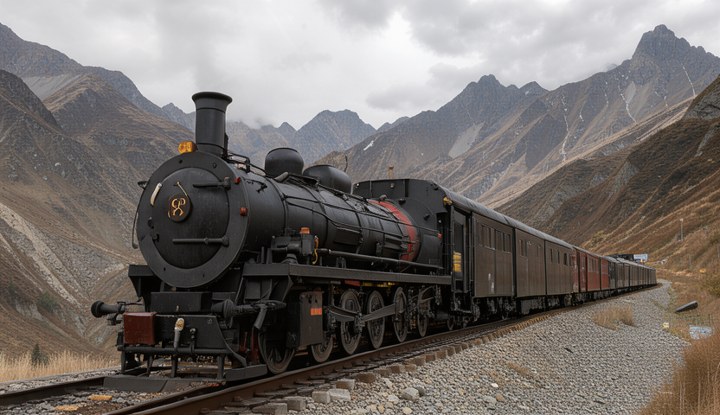
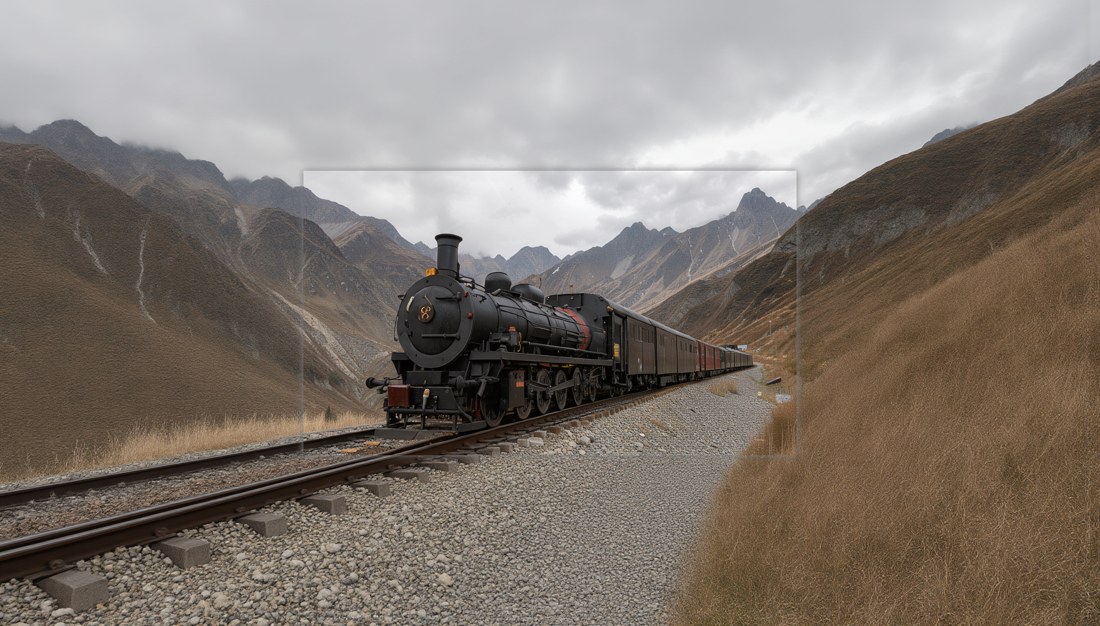
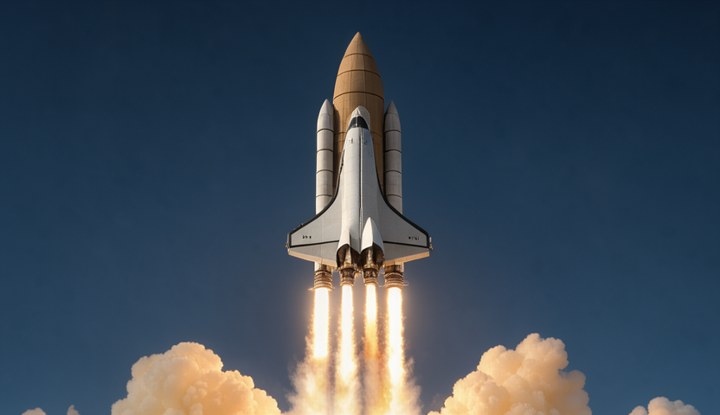
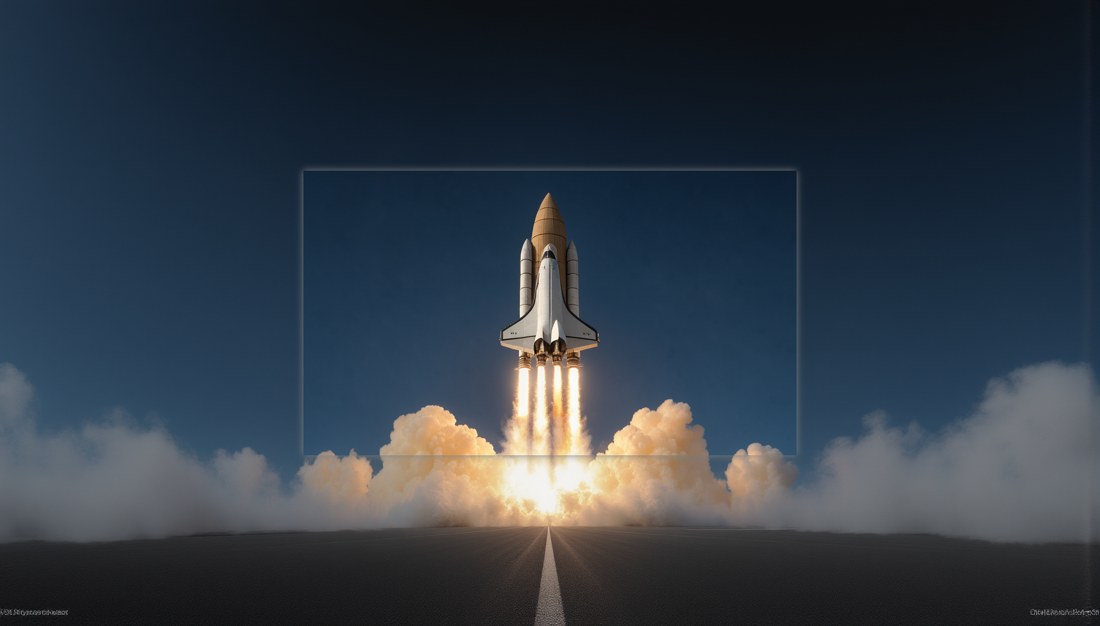
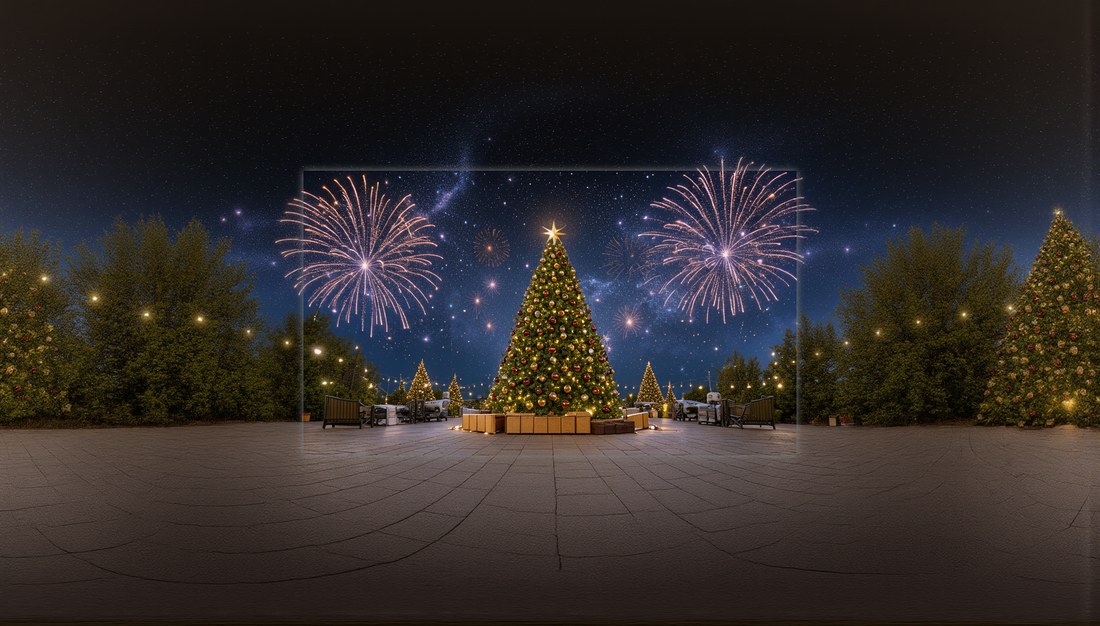
Left to right: the input image, the canvas that extends it beyond its original field of view while preserving the input pixels, the rendered guide of approximate target views, and the steered output. Only the guide's low-frequency structure reaches the model.

zoom out
1
Input image
2
Canvas (FLUX.1 Fill outpaint)
3
Rendered guide along the path
4
rendering…
Steered output (Wan 2.2), steered for the first 40% of steps
Choose the steering duration to control the camera travel 20%80%40%
tilt up
1
Input image
2
Canvas (FLUX.1 Fill outpaint)
3
Rendered guide along the path
4
rendering…
Steered output (Wan 2.2), steered for the first 40% of steps
Choose the steering duration to control the camera travel 20%80%40%
pan left
1
Input image
2
Canvas (FLUX.1 Fill outpaint)
3
Rendered guide along the path
4
rendering…
Steered output (Wan 2.2), steered for the first 40% of steps
Choose the steering duration to control the camera travel 20%80%40%

Abstract

Video diffusion and world models generate plausible videos but do not reliably match the requested camera direction and travel distance. We present DreamTour, a training-free framework that generates camera tours from a single image with more accurate control over camera motion. DreamTour first uses a frozen image inpainting prior to extend the photograph beyond its original field of view while preserving the input pixels. Depth-based rendering of this extended scene along the requested camera path produces approximate target views that serve as spatial guidance. We introduce Layout Steering, which aligns early video latents with these views through decaying low-frequency corrections, leaving later denoising to refine appearance and dynamics. For longer tours, we autoregressively generate the video segments, repeating guidance construction from each segment’s final frame to maintain camera control across the full trajectory. DreamTour improves directional accuracy and travel calibration on VBench while maintaining competitive video quality. On WorldScore, it strengthens camera control and scene consistency across chained movements. Together, these results demonstrate that training-free spatial guidance enables more accurate and consistent camera control in pretrained video diffusion and world models.

Method

Expand the input image once, render the requested path, steer early denoising with decaying low-frequency corrections.
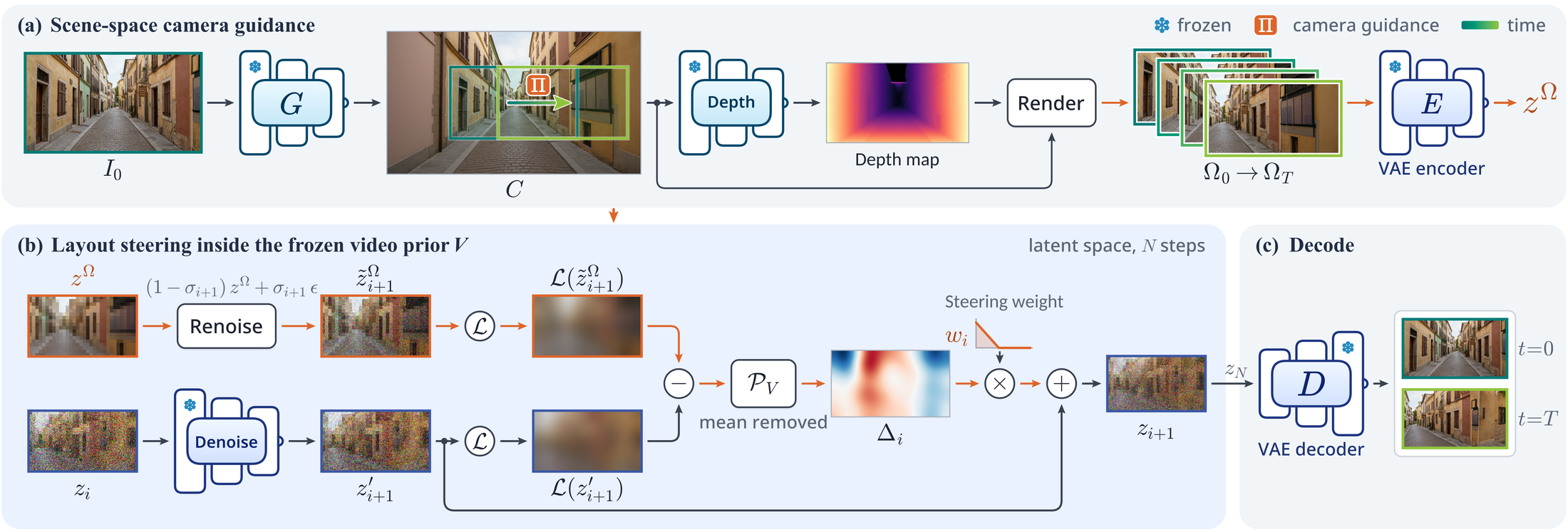
Overview of DreamTour: a frozen inpainting model expands the input image into a canvas, views rendered along the trajectory with Pi3X depth are encoded as the guide latent, and decaying low-frequency corrections steer early denoising of the frozen video model

A frozen inpainting prior (FLUX.1 Fill) expands the input image into a canvas in one pass, with the input pixels preserved exactly. A depth estimate, rescaled once to the scene's metric median depth, lifts the canvas into a textured point cloud, and rendering it along the requested trajectory produces a guide video of approximate target views. During the first 40 percent of denoising, Layout Steering adds a decaying low-frequency correction that aligns the video latent with the noised guide latent, and the remaining steps run the frozen sampler unchanged, so the prior supplies parallax, disocclusions and fine detail. For longer tours each window starts from the previous window's final frame, with a fresh canvas and guide. All pretrained weights remain frozen, and this training-free design applies to both image-to-video diffusion models and camera-conditioned world models.

Layout steering on a frozen video prior: Wan 2.2

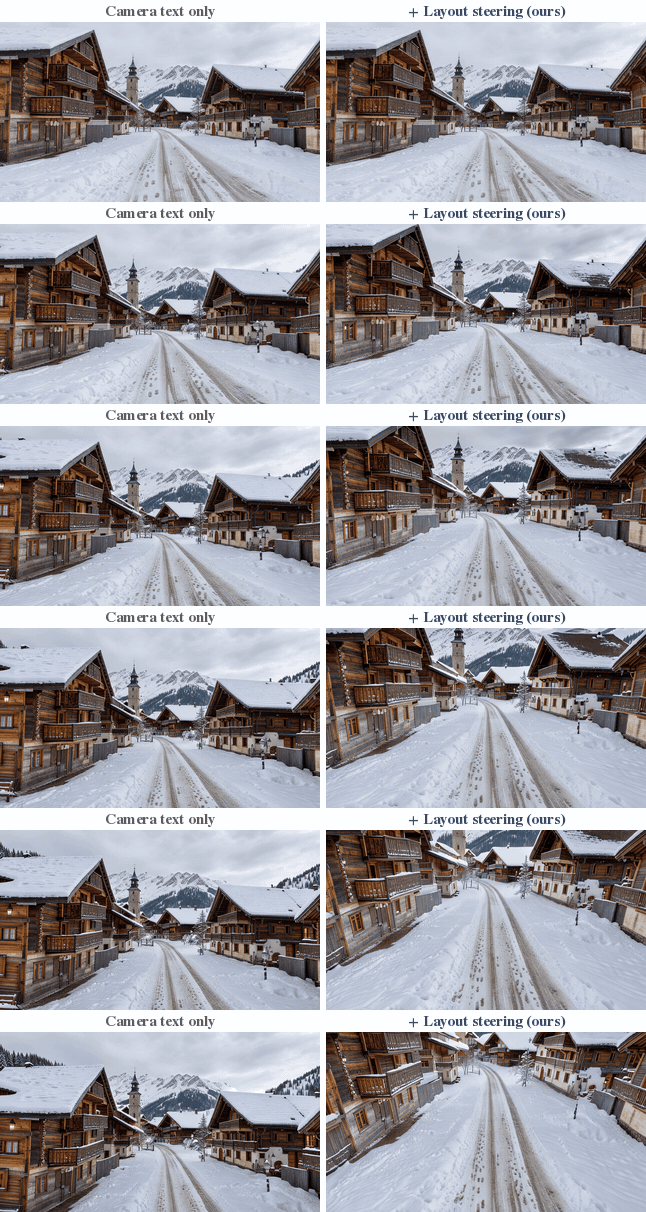
One input image, one camera request. Left of the divider: the frozen prior (Wan 2.2 TI2V-5B) with the camera sentence alone. Right: the same prior with layout steering. No weight is changed: the guide constrains camera motion and coarse structure, while the frozen prior supplies realistic appearance and dynamics. Drag the divider.

Bird's-eye, rise 2 m

Orbit left, 15°

Bird's-eye, rise 2 m

Pan right, 20°

Inside a trained world model: SANA-WM

A camera-conditioned world model follows the direction; Layout Steering calibrates the travel distance.

SANA-WM takes the camera trajectory as an input and still travels only part of the way: on these 1.6 m moves the trajectory alone covers 8–24 % of the request. With its native trajectory input retained, Layout Steering carries the camera the rest of the way (43–65 %) at unchanged direction, and does the same on trajectories the model was never trained on. Left: trajectory input alone. Right: the same input with layout steering.

Rise, 1.6 m

Truck right, 1.6 m

Rise, 1.6 m

Truck right, 1.6 m

Inside a trained world model: Lyra 2.0

Layout Steering, unchanged, calibrates a second camera-conditioned world model with its trajectory input retained.

Lyra 2.0 generates worlds from a single image and a metric camera trajectory, yet the realised travel drifts far past the request, up to fourfold on these scenes. Layout Steering calibrates it, with Lyra's appearance untouched. Left: trajectory input alone. Right: the same input with layout steering.

Rise, 1.6 m

Truck left, 1.6 m

Truck right, 1.6 m

Forward, 1.6 m

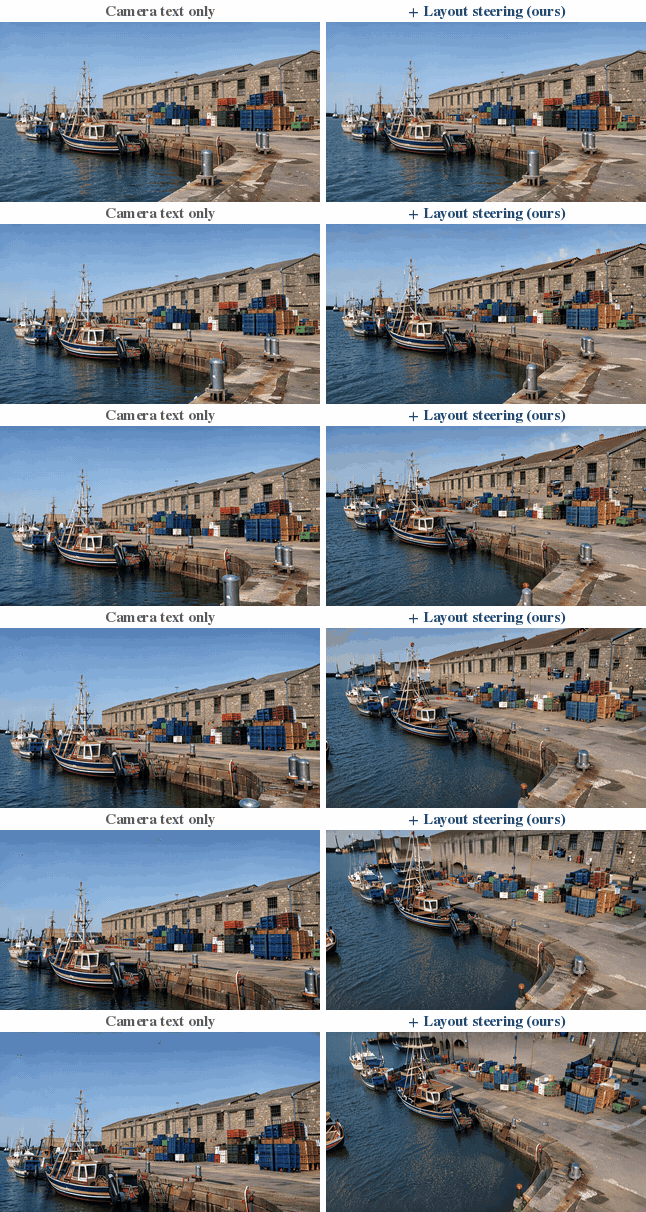
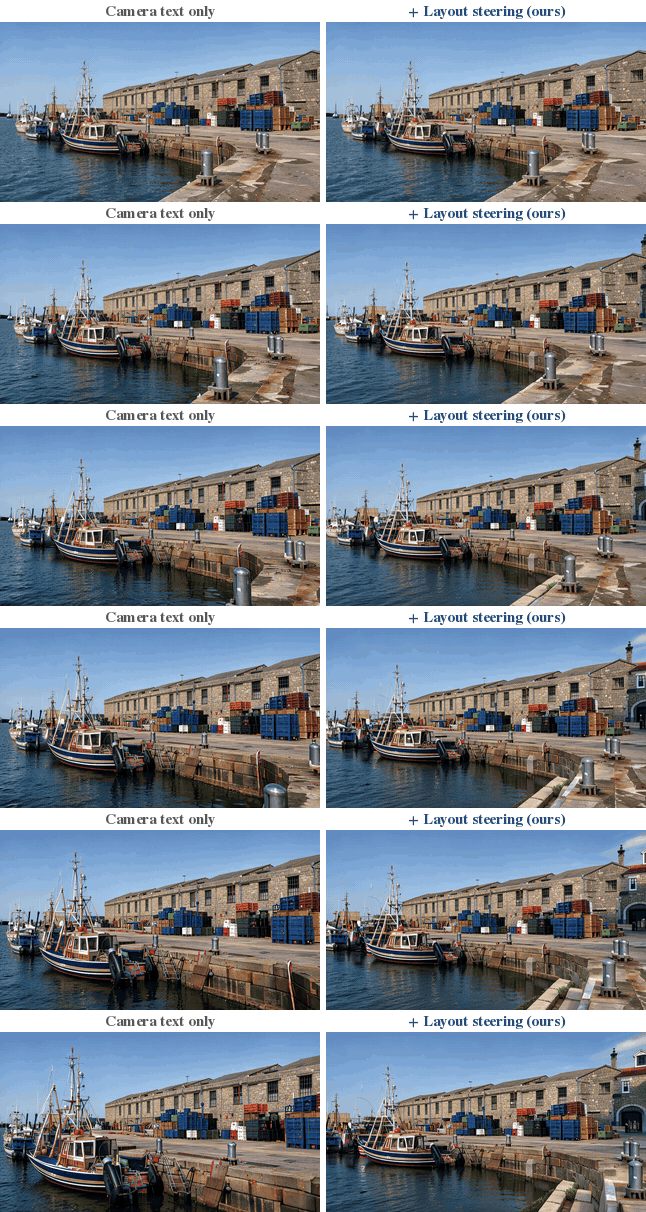
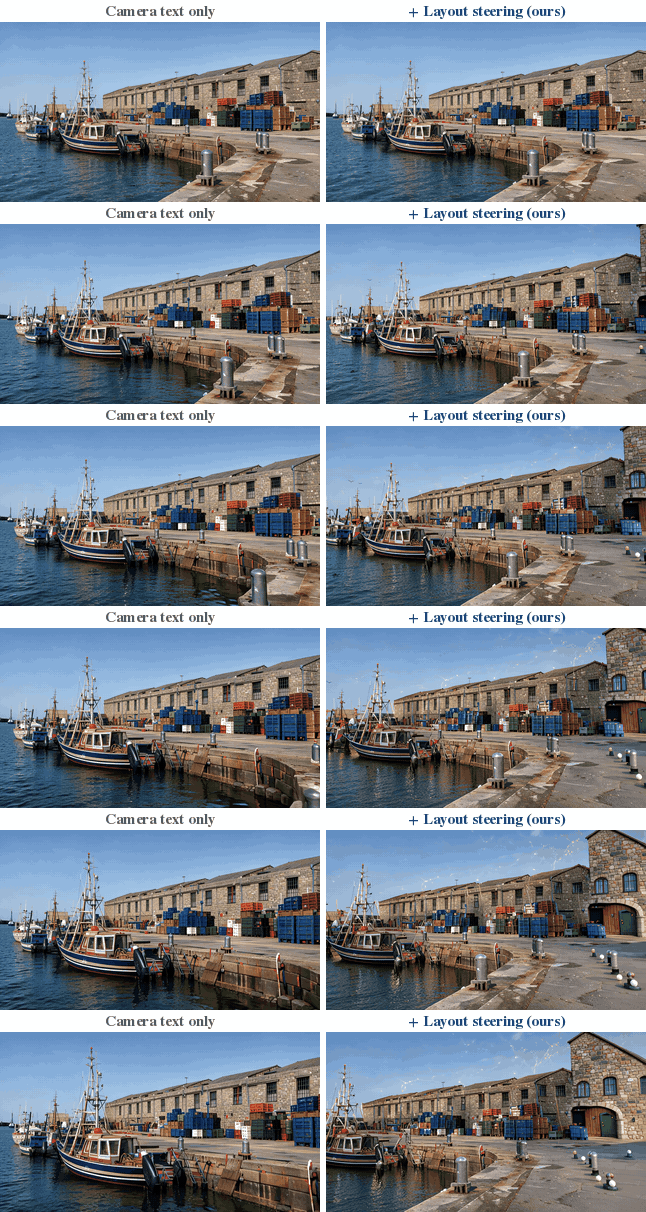
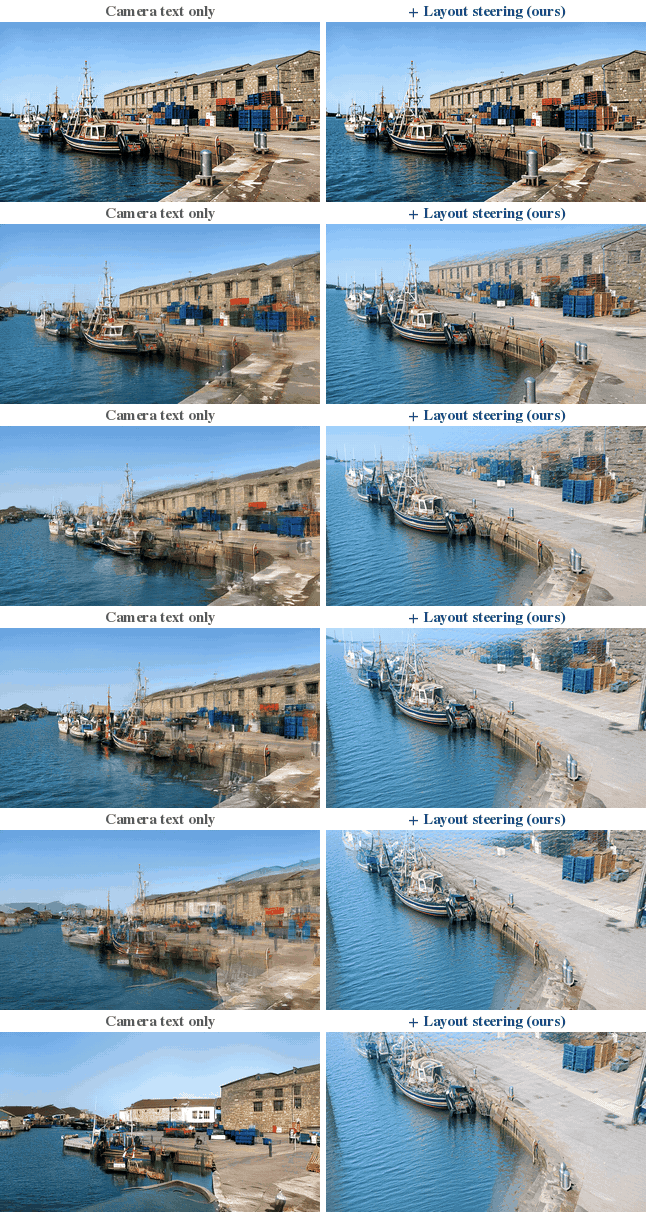
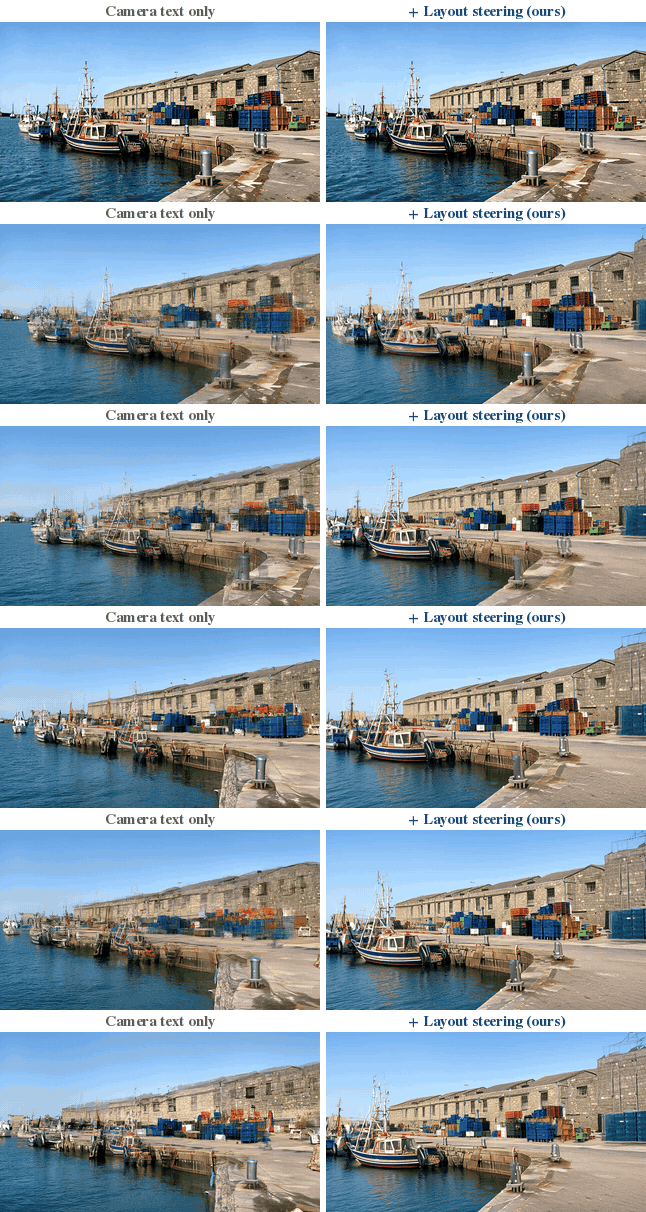
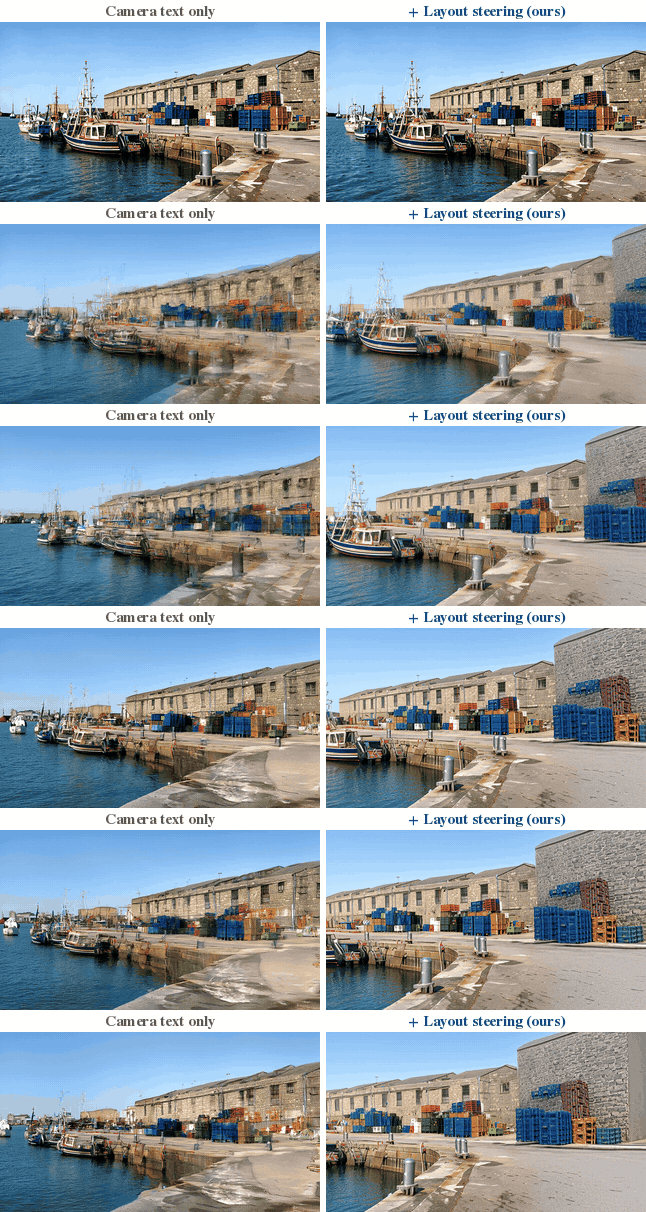
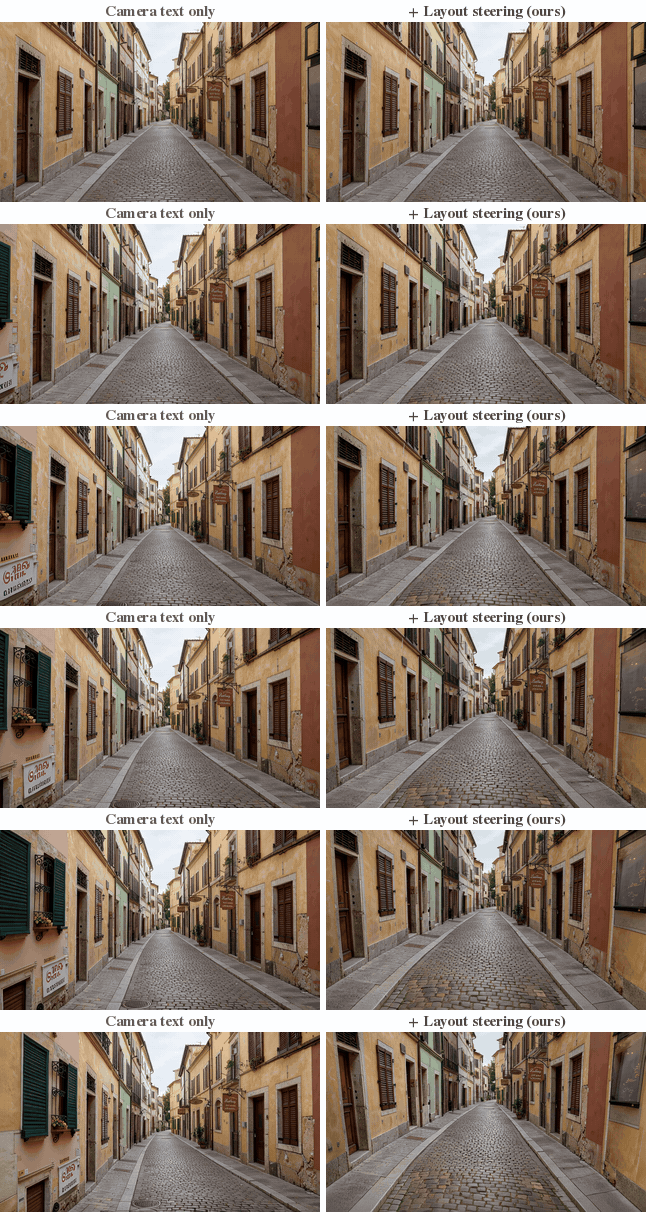
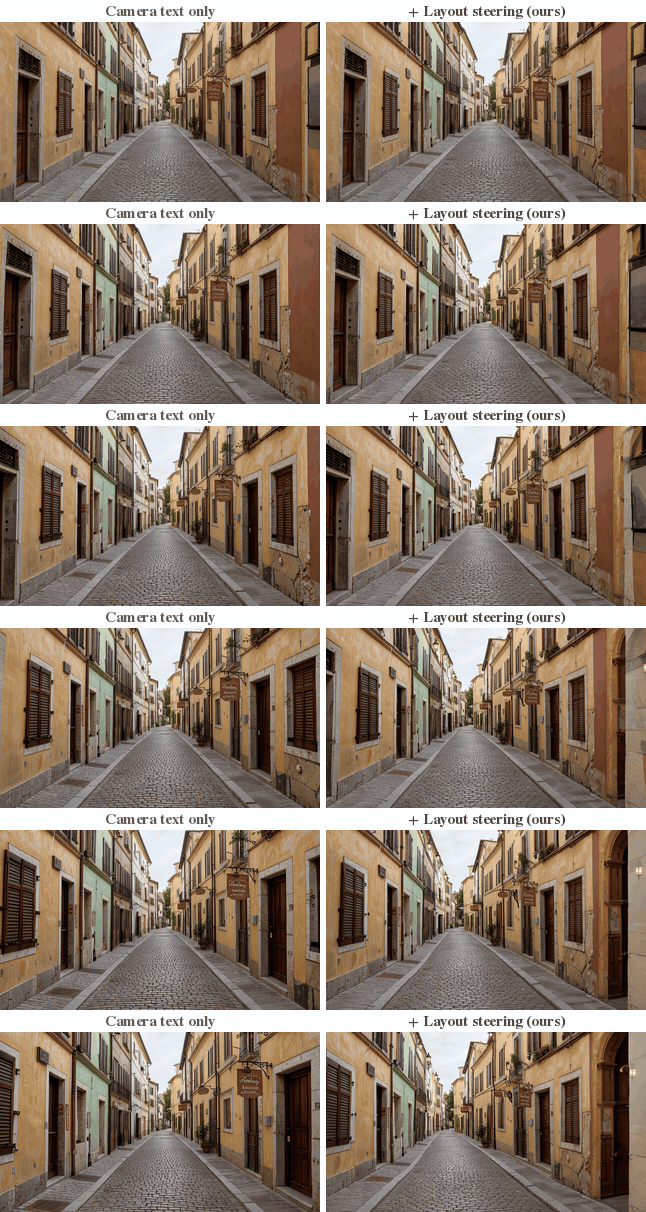
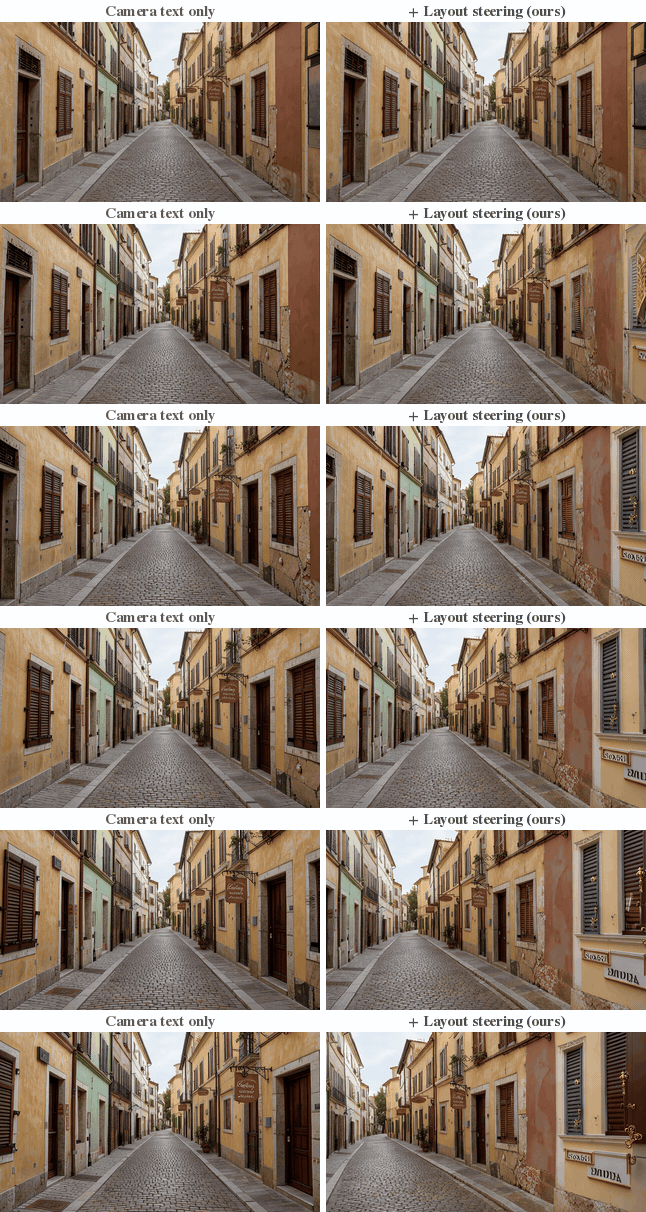
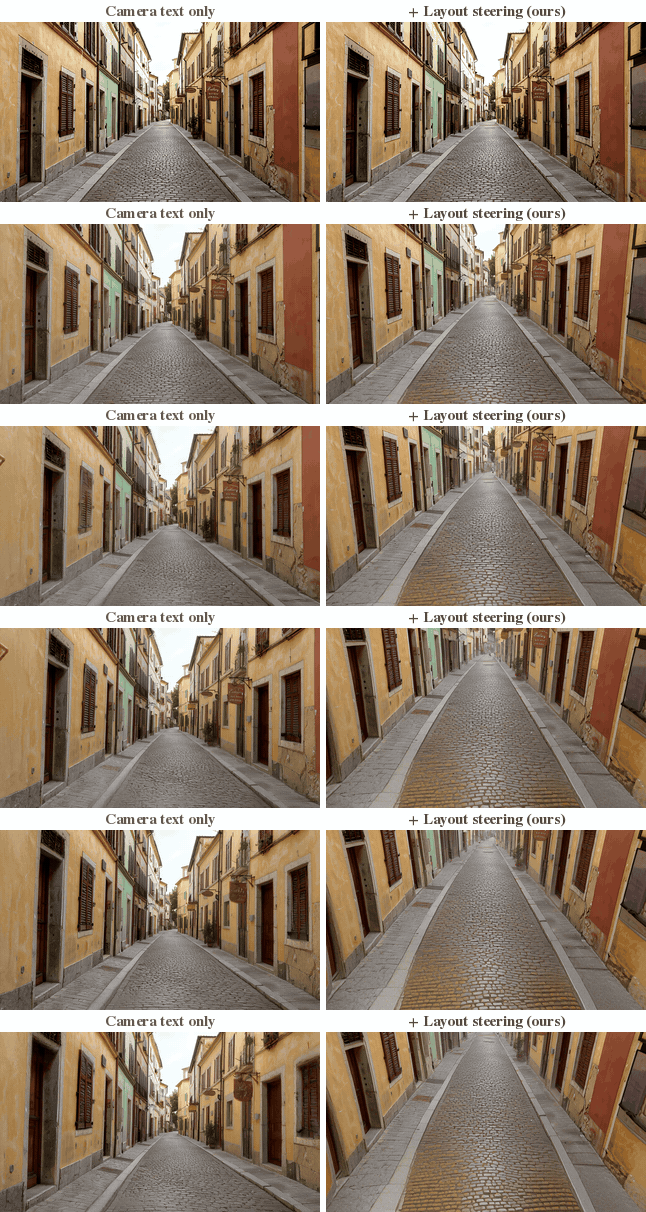
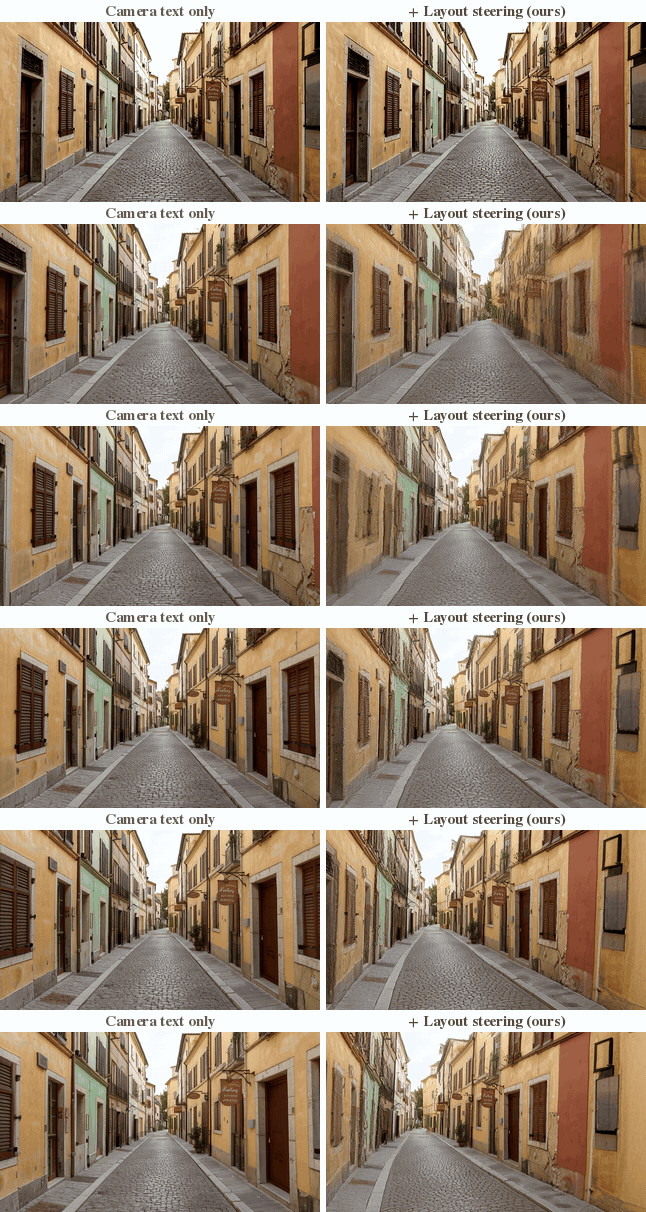
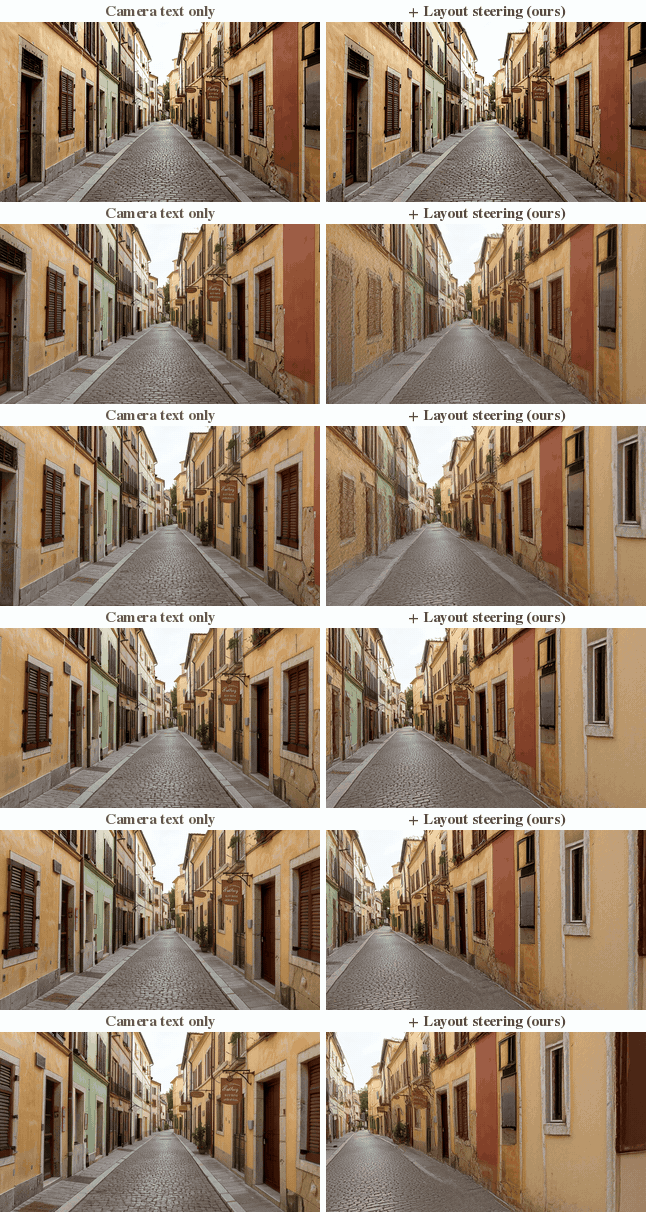
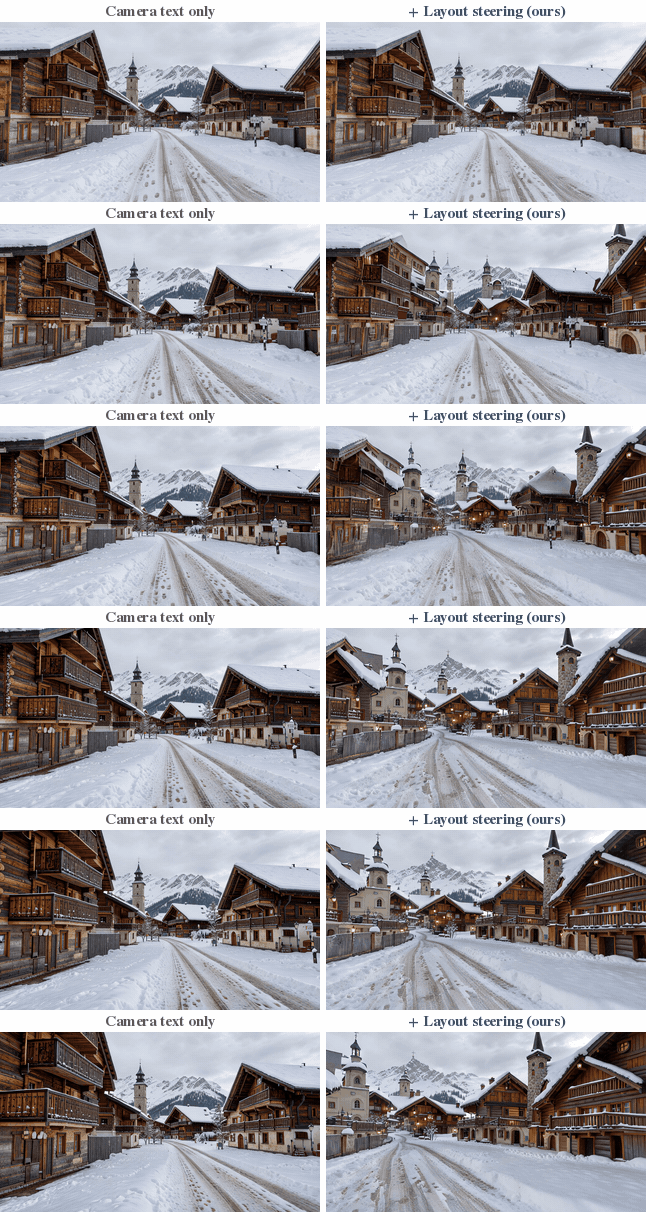
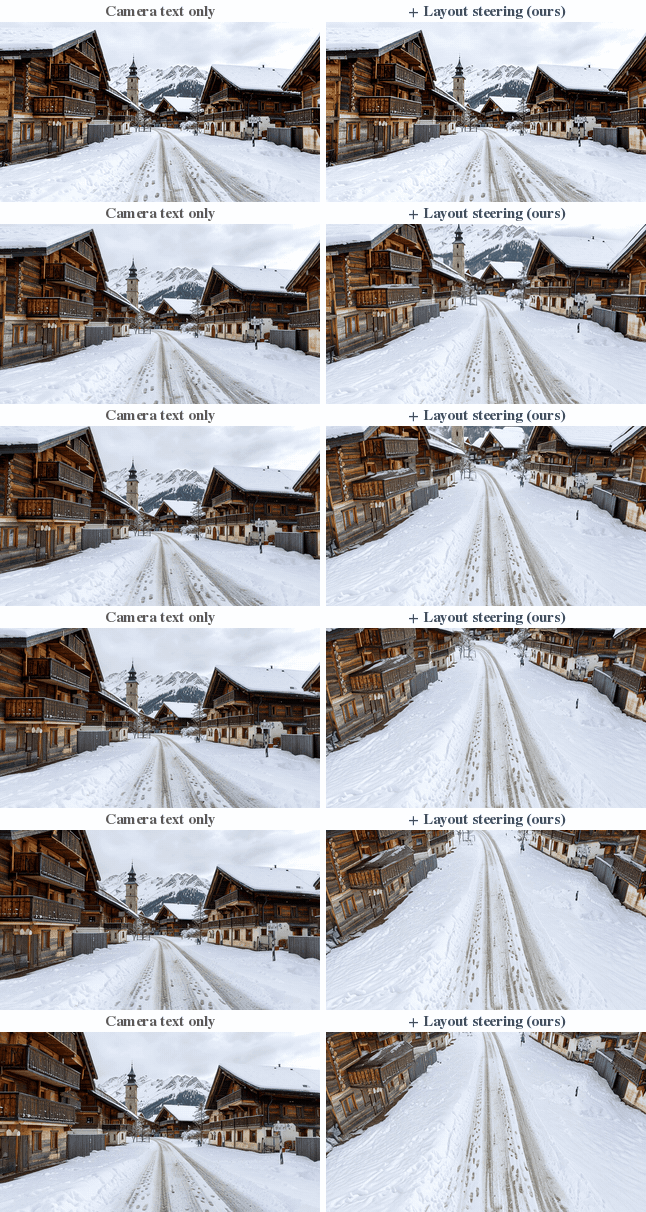
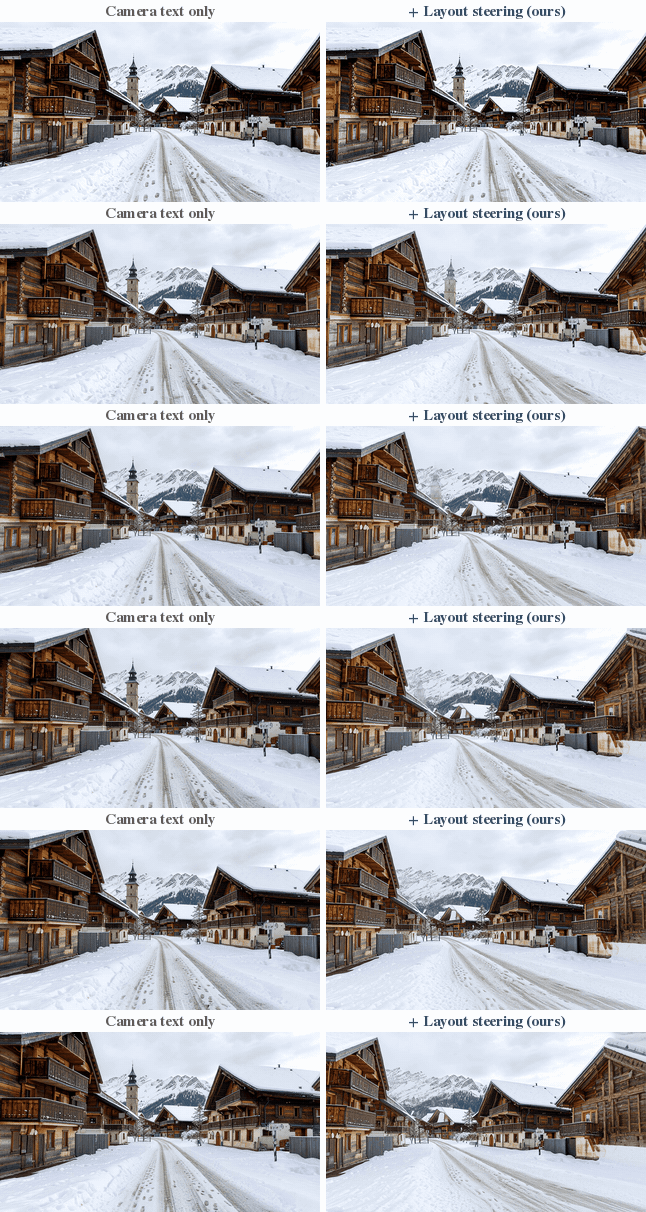
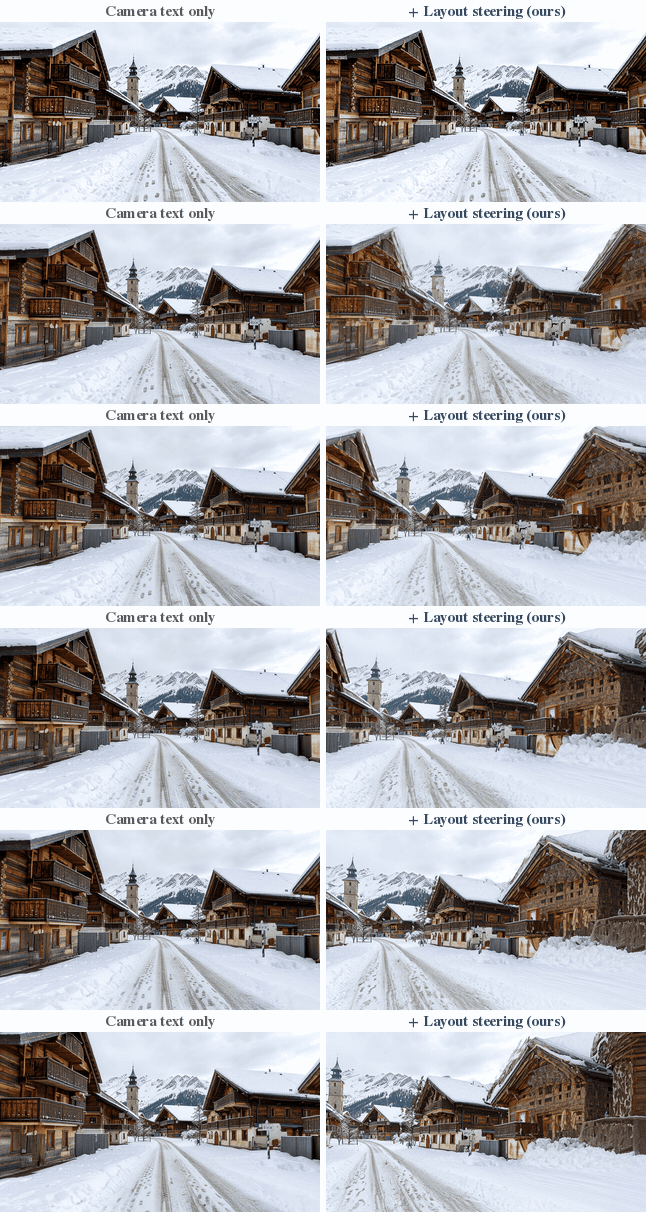
Camera control, side by side

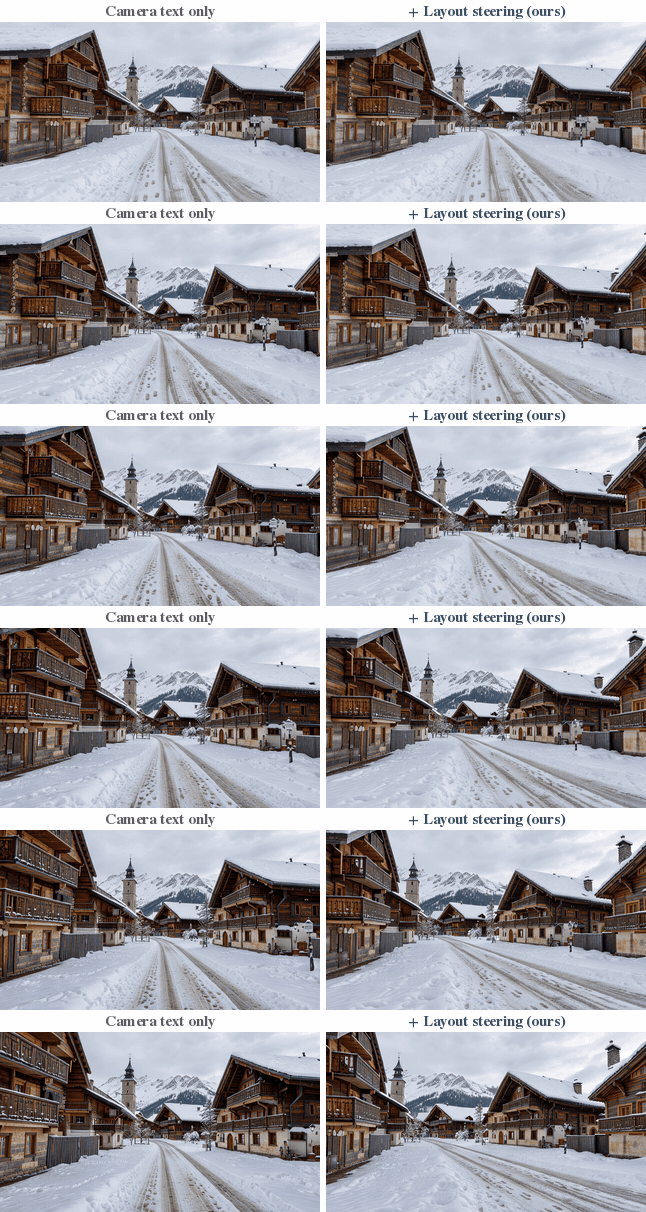
Each pair: the model's own camera control, then the same frozen model with layout steering.

Benchmark cells from the paper. Each column shows the model's own camera control above layout steering added to the same model (blue frame).

Wan 2.2 TI2V-5B

Forward

Camera text

+ Layout steering (ours)

Tilt up

Camera text

+ Layout steering (ours)

Truck right

Camera text

+ Layout steering (ours)

Zoom out

Camera text

+ Layout steering (ours)

SANA-WM

Forward

Trajectory input

+ Layout steering (ours)

Tilt up

Trajectory input

+ Layout steering (ours)

Truck right

Trajectory input

+ Layout steering (ours)

Zoom out

Trajectory input

+ Layout steering (ours)

Lyra 2.0

Forward

Trajectory input

+ Layout steering (ours)

Tilt up

Trajectory input

+ Layout steering (ours)

Truck right

Trajectory input

+ Layout steering (ours)

Zoom out

Trajectory input

+ Layout steering (ours)

One method, three priors

The same Layout Steering, the same canvas and guide, applied to three frozen video priors.

No weight is changed. Bird's-eye, orbit and pan from one input image per scene.

Bird's-eye, rise 2 mOrbit left 12°Pan right 20°
Wan 2.2
SANA-Video 2.0
CogVideoX 1.5
Bird's-eye, rise 2 mOrbit left 12°Pan right 20°
Wan 2.2
SANA-Video 2.0
CogVideoX 1.5
Bird's-eye, rise 2 mOrbit left 12°Pan right 20°
Wan 2.2
SANA-Video 2.0
CogVideoX 1.5

Results at a glance

The paper's quantitative tables: camera control under the CamProbe protocol, WorldScore, and the human study.

Eight camera motions on the 93 VBench prompts, poses from Depth Anything 3, no trajectory alignment or scale fitting. Shaded rows apply layout steering to the frozen base model; the training column marks camera-control training beyond the base prior.

Camera Control ↓Camera Aim & Displacement ↓Video Quality ↑
Base video priorMethodTrainingRPE-T (m)RPE-R (°)Dir. (°)Travel Err.Rot. Err.ImagingSmoothnessConsistency
Cosmos-Predict1 7BGen3C✓0.0440.675.20.360.0570.8499.2197.09
+ Layout Steering (Ours)✗0.0380.5944.30.320.4470.9799.2496.97
CogVideoX-Fun 5BTrajectoryCrafter✓0.0580.8437.60.650.5170.9099.2096.14
+ Layout Steering (Ours)✗0.0450.8832.60.590.4869.2998.7996.21
Wan 2.1 1.3BReCamMaster✓0.0340.5826.50.630.3070.8199.2496.03
+ Layout Steering (Ours)✗0.0310.4929.00.550.4271.0898.8496.42
Wan 2.2 5BCamera Text Alone✗0.0531.1893.81.011.0271.4998.1595.49
+ CamTrol✗0.0450.8878.01.000.9570.9399.1298.00
+ CamProbe✗0.0650.7770.70.990.8968.5899.0896.03
+ Layout Steering (Ours)✗0.0400.7432.40.680.3971.3399.7698.27
SANA-Video 1.0 2BSANA-WM✓0.0390.6070.01.001.0071.6699.2997.95
+ Layout Steering (Ours)✗0.0320.4137.30.680.3971.7399.4097.95
Wan 2.1 14BLyra 2.0✓0.0670.7056.02.121.0671.8599.1095.30
+ Layout Steering (Ours)✗0.0480.6455.81.640.6471.8999.1994.98

BibTeX

@misc{dreamtour2026,
  title  = {DreamTour: Layout Steering for Training-Free World Exploration},
  author = {Sastry, Srikumar and Karumuri, Meher Gitika and Li, Chenqi and Bose, Sarosij and Zhang, Mellon and Tu, Allen and Long, Ziyang and Lin, Yen-Liang and Schwing, Alexander and Jacobs, Nathan},
  year   = {2026}
}

Acknowledgements

This work was completed during an internship at Amazon. We thank Amin Kheradmand, Avinash Ravichandran, David Stafford, Pranav Sankar and Shifan Zhu for helpful discussions and feedback.

Page layout after the GOFish and Nerfies project pages. Comparison sliders: drag or use the arrow keys; Space pauses.